Monday, June 28, 2021

VN Talk: Raging Loop

In which I talk (write) about visual novels from a storytelling perspective...

Platform: Switch
Release: 2019

I debated whether it was a good idea playing Raging Loop back to back with Gnosia given that they're both visual novels built around the Werewolf party game, but beyond that initial conceit, they're quite different experiences. Unlike Gnosia, where you play each game yourself, Raging Loop weaves a single game tightly into the narrative so most of the choices are made by the protagonist with the player only making decisions at key points.

Raging Loop integrates the mechanics of the Werewolf game into a fictional religion practiced by a small village in rural Japan. The people of Yasumizu believe that when the evening mist comes, a number of their fellow villagers are replaced by wolves, and the wolves will kill villagers at a rate of one a night until all the wolves are hung. Aiding the villagers are various guardian spirits who will bless one of the human villagers with guardian specific abilities such as protecting one villager a night from the wolves, or being able to look into a specific villager once per night to see if they are human or wolf. It's very much the Werewolf game.

Though, in a nice twist, making choices that are sensible in Werewolf might not be in Raging Loop because there is no "team win" condition. The story can't continue if the protagonist dies, which can make for some selfish plays.
Our "hero" in this adventure is unsurprisingly an outsider, Haruaki Fusaishi, who gets lost in the mountains at night while trying to get over his break-up, when a convenience store clerk directs him to the village of Yasumizu. From there, he gets tangled up in the local tradition when the mists come, and to his surprise he finds himself looping back in time to his motorcycle ride through the mountains every time he dies. (Fortunately the player can just jump to the last decision point even though from a story perspective Haruaki has to go aaaaaaaaaalll the way back.)

Haruaki doesn't know exactly what's going on, but figures that getting involved in the game is the best way to figure out what's happening to him and stop the loop.

He's a rather unusual protagonist in that he's not a particularly nice or heroic character. Haruaki is capable of doing the right thing, but generally only does so if he cares about the person he's doing the act for (which eventually becomes most of the people in Yasumizu) and he does some pretty awful things throughout the story while trying to figure out his situation, because more than anything else, he wants to get out of the loop while keeping himself alive. You can see this best when he takes on the wolf role.

There are three primary timelines in the story; one where he does not directly participate in the game, one where he participates as a human, and one where he is a wolf. The wolf is the third timeline he experiences and since winning the game as a human didn't end the loop, he tries winning as a wolf, which means murder. He has no idea whether winning as a wolf will stop the loop or just give him more information, so killing people could mean a permanent death for them. Even allowing for experimentation, and giving him the benefit of a doubt (that he assumes they'll resurrect with another loop) when he kills people it's not just a quick shot/stab and they're dead. He goes about desecrating the corpse until it barely looks human, which is far more than he needs to do in order to keep up his act as a wolf.
Haruaki is something of a chameleon, shifting his morals depending on his role and involvement in the game, and to some degree who his current love interest is, as he gets a different gal on each timeline (though he eventually ends up with Chiemi on the true route). Nobody really knows him given that he's a stranger to the village and even though he introduces himself early on as a graduate student, his knowledge of forensics suggest something more. One villager even asks if he's a detective, but he's actually a mystery author; the other kind of occupation which would wallow deep into murder methods.

Haruaki's sense of narrative comes in handy in deconstructing the local legend that started the tradition and questioning why the game works the way it does. For instance, why are the vengeful wolves who have risen from the dead restricted to killing only one person a night? According to legend they're on the outs with the mountain god, so why would they play by his rules?

He comes to realize, in the face of actual supernatural events (including his own looping), that the game itself is a manmade construction; hence the arbitrary rules. The legend is a real local legend and the tradition of hanging fellow villagers as wolves was a real tradition, but the full on murder game version is a "recent" development (less than a hundred years old).

I like what the game did with the origin of both the tradition and the murder game by tying it into how religion can evolve for political/cultural purposes of control (like how pagan traditions became part of mainstream Christianity in the form of Christmas trees and Easter bunnies). In this case, the greater village of Kamifujiyoshi sends its undesireables to live in Yasumizu, but because it fears the potential for trouble should Yasumizu's inhabitants bite back, it has historically controlled them through the legend and the tradition of hanging wolves, which causes the people of Yasumizu to suspect and kill their own, thus preventing them from ever focusing on their true oppressor.
What's less clear is why Kamifujiyoshi later escalated the tradition to a level where it appears to be supernatural. It is a ridiculous amount of work to put on the game, and while it's mostly possible with current technology, it's also wildly impractical for dubious benefit. Yasumizu only consists of eleven residents at the time the present day game begins, which includes elderly and high schoolers. That's hardly a number to be feared when the larger village likely numbers in the hundreds.

The game also doesn't go into what would happen if the wolves won. While the odds are against the wolves winning in a game with equally savvy players, they could still win and that would leave a maximum of three remaining villagers (since the wolf villagers will kill any remaining humans upon winning). Is that to any benefit to Kamifujiyoshi?

Once we realize the game is a human construct, it calls into question some of the happenings throughout the game. For instance, we know the wolves are actually villagers given the role of "wolf" rather than being replaced by wolves. They're drugged and told an alternate version of the legend that claims all the other villagers are already dead and the wolves are doing them a favor by killing them and sending them back where they belong.

While it's understandable the wolves would remember the telling as a dream, I don't find it believable the degree to which the wolves fall into the role of butchering friends and family. The only wolves who wonder what the hell is wrong with their fellow wolves are outsiders like Haruaki and the reporter, Hisako. Everyone else brings out the guns and the knives and murders like it's the easiest thing in the world.
Are they just that fanatical about their religion that they can accept killing is the right thing to do? They don't show a hint of distress during the daytime deliberations that would suggest they've been traumatized by what they've done. Even Chiemi, who is looping just like Haruaki, and has seen both the wolf and non-wolf sides of the story, still goes on a murder spree when she's a wolf.

So now that we know the game is not supernatural, why is Haruaki looping?

The answer is that someone is using the game to get everyone in Yasumizu killed in order to fuel a ritual that will ruin Japan, and this part of the story doesn't quite hold together as well. Basically Ritsuko, sort of a village holy woman, follows a god that appears to have been displaced by the better known national pantheon of Japan, and her ancestors subsequently rammed their deity into the local religion so it would have a place to exist, however awkward.

As the last of her line, Ritsuko carries the accumulated grudges of her ancestors and wants to avenge her god's displacement. She planted the seeds needed for its resurgence in the various villagers and to reclaim that power and resurrect her god they all need to die, so she planned the loop to happen during the game, with the hope of eventually getting all the villagers killed in a single run (which happens thanks to Haruaki when he's in the wolf timeline).

Each time she dies, the loop begins again, giving her another chance to achieve the result she desires, but someone else is trying to stop her and ends up using Haruaki as the instrument to do so. Realizing that the loop is tied to Ritsuko rather than Haruaki was a nifty reveal, as well as explaining why he sometimes seems to loop in some endings without an obvious death.
But I just had trouble following this part of the plot and understanding how her god (and whether it actually is a god) fit in the larger backstory about how the present day religion came to be. Ritsuko's god is not the only supernatural entity to play a role in the story either, so it's not like the game writer is incapable of mixing the supernatural with the mundane. Haru's almost forgotten badger god (the original god of the mountain before humans displaced it with the current religion) fits perfectly into the space it's given, which is likewise substantial.

It doesn't help that the defeat of Ritsuko's god in the true end is entirely a deus ex machina that goes unexplained unless you read the optional epilogue stories. That doesn't change that our protagonist completely lucked out of a situation he could not have handled himself, but at least it's possible to know what happened.

Though Raging Loop's big picture flounders at the end, it does small details well. There's a lot of kanji play in this game, involving reordering the kanji that make up names, taking apart kanji into its components and rearranging them, or using alternate readings of kanji, and all of it is translated into an easy to follow format that doesn't require Japanese fluency.

And for a game with a lot of gruesome murders, there are a number of silly moments to break the tension (some of which can only be seen on New Game+ unfortunately). The fact the convenience store at the start of the game has any number of tools that Haruaki needs (even, at one point, a bulletproof vest) is a running gag. And it's hard not to laugh when Haruaki is being tormented by a sheep, especially when it's his fault for pissing off said sheep.
Which brings me to the last thing I want to talk about.

Mitsuki, whose psychic avatar is the sheep, is the one preserving Haruaki's memories each loop. She's not a villager, and in fact is Haruaki's ex. But even though I love Mitsuki as a character (she's tough, genderqueer, and smart enough to dump Haruaki), the game doesn't do that great a job with her, and it's largely because the game intentionally hides knowledge that the player should have as Haruaki.

She's the first person he meets in the game where she's disguised as the convenience store clerk. In New Game+ we get extra mental dialogue from both of them that shows he recognizes her, but he's still pissed about the breakup so he pretends she's a stranger, and she reciprocates. The NG+ version of the scene is hilarious, and shows just how well they know each other after years of dating, but the original one removes all mention of the fact Haruaki knows her even though we get all his other internal thoughts about her attitude.

I can understand not wanting to derail the horror/mystery setup by having snarky comments about his ex in one of the very first scenes, but by selectively choosing what Haruaki shares with the player it makes her sudden cooperation in the finale strange. (Which is another way Raging Loop drops the ball towards the end.) We never see the conversation when Haruaki asks Mitsuki to help him save the villagers, not even in NG+, so when she showed up the first time out of her shop clothes and Haruaki started talking like he knew her, it took me a moment to figure out that she was the much talked about ex. If I hadn't played Raging Loop regularly until I finished I might not have made that connection at all.

Though Mitsuki's role is small, it's a critical one, and I think there could have been a middle ground between the ignoring each other circus and leaving the player in the dark.

Monday, June 14, 2021

May/June Publications

Due my ongoing health issues, I've fallen behind on a lot of things, but I got a little nudge in the mail last week when my contributor copy of the Cooties Shot Required anthology arrived!

While it's up on Amazon as a pre-order for August, a reader let me know he read my story before I even got my copy (!), so it seems some people have already gotten their pre-orders; perhaps though the Whether Change Kickstarter or directly pre-ordering through Broken Eye Books.

My anthology story is "Those Who Want Power" which is a dark mix of tournament anime and high school anxiety.

Also, running late on this one, but my short story "The Roast Meat Squadron" is currently up in the May issue of Galaxy's Edge and should be free to read until the July issue comes out.

Monday, May 31, 2021

VN Talk: Gnosia

In which I talk (write) about visual novels from a storytelling perspective...

Platform: Switch
Release: 2021

After I got out of the hospital from my stomach cancer surgery, I was in pretty poor shape, and that included my ability to game. My left hand was painful to use for more than the occasion button press and my stamina required something I could pick up and put down at a moment's notice. Which meant: visual novel, which is very playable using a single hand.

Additionally, I wanted something that by its nature I wouldn't use a walkthrough for (so I wouldn't need to juggle an additional device), which meant a mystery game. I chose Gnosia which had just come out a couple weeks before my surgery.

It takes place on a spaceship carrying refugees from Liu-An, which was attacked by Gnosia; humans who have been infected by Gnos. At the outset, no one knows what Gnos is, or what the Gnosia want, but it's clear that the Gnosia are enemies and they cause people to disappear. Their victims unravel from existence as though they never were. Gnosia are indistinguishable from the people they used to be aside from their new malevolence towards humanity, so discovering one is a game of suspicion and catching them in a lie.

I quite enjoyed it, but be aware this game came out this past March and I'll be discussing spoilers in the rest of this post.

When the game begins the circumstances are simple enough. Gnosia have been detected on board, and there are five crew members. One of them is infected and needs to be put into cold sleep before they can disappear members of the crew, which they will do at a rate of one a night (when the ship enters warp). It's essentially a game of Werewolf or Mafia, where all the other players are NPCs with predefined personalities that make it easier to raise suspicion against them, easier to earn their trust, or make them a formidable pain in the ass if they happen to be your enemy.
Since the nameable main character is stuck in a time loop (which crosses parallel dimensions), most of the game involves playing dozens of games of Werewolf that tend to last around 10-15 minutes (assuming the player isn't taken out early). Sometimes the MC is human, sometimes they're Gnosia, and eventually the player is able to command their looping enough to pick out which role they want (human characters can also have specialized roles like "engineer" which allows them to scan one crew member a night to see if they are human or Gnosia) as well as how many crew members and Gnosia are on board.

Though that is the bulk of the gameplay, the meat of the story consists of discovering what the Gnosia are, what they want, and why the protagonist is looping in the first place.

The answers are doled out in a haphazard manner. I'm not sure if there's a specific loop number requirement for some scenes, but there are certainly crew member requirements. The entire potential of fifteen (sixteen including the MC) might not need to be present, but there can be requirements like the player has to be crew/Gnosia and other characters might need to be one or the other as well. In one case, I had to win with me and one other character as the sole survivors, but I don't know what prompted her to present that win condition to me since she had been in many games with me prior to that one.

As a result, it can be a little hard to get a sense of progress. For me, the game slogged the most around the 60s and 70s (out of what ended up being 134 loops for me personally). At that point, it felt like the easy to trigger events had already shown up, and there were too many remaining events for the event search function to help me narrow down what I was missing.
The thing is, at one point it becomes apparent that you need to fill in all the background notes about your fellow crew members, and you learn more about them through events. The event search unlocked around the 50-60 loop range for me and what it does is set the crew/Gnosia numbers and the roles to conditions that can potentially trigger an event, but you don't know who the event will involve. Additionally, events in the loop itself can thwart you. Maybe the character you need will become a Gnosia victim before the event can trigger, or maybe they need to be Gnosia but this run didn't set them in that role.

A few dud rounds that are "just" a game of Werewolf isn't too bad, but sometimes I'd have more than five in a row, which got tiring. But as I had fewer and fewer events left, it became clearer which characters I needed to focus on and protect, to the point that when the end finally came, it felt like an incredible rush given the prior pacing.

Fortunately, not everything in the game is about Gnosia, so when events do trigger, you can be rewarded with moments of levity rather than one more scene in pursuit of the dire truth. And Gnosia the game leverages these scenes well.

One of my favorites involves Setsu, who is the only crew member besides the protagonist who is looping. After several dozen loops, they start getting tired of all the looping and the struggle to progress, and you have the option of either encouraging them to continue, or telling them to play. If you select play, the MC and Setsu essentially take a loop to goof off and go fishing in the ship's water tanks (or go watch a movie).
It's just the break the characters need, and I needed as a player. They know they're going to loop again, so taking a little time off doesn't hurt, and they have some fun before they're put in cold sleep by the rest of their non-looping crewmates (who understandably find their behavior suspicious).

The events I remember most are things like that; the shenanigans, like the time Comet's symbiotic slime went out of control and Sha-Ming noped out into indefinite cold sleep even though he was Gnosia, or the time Shigemichi was iced in the very first round when he was the only Gnosia, causing the game to end without any casualties.

So what about the main plot?

I found I didn't quite like it as much as I liked unraveling it, and that if I poked at it too much it starts to fall apart. While we do learn what Gnos is and why the Gnosia do what they do, there's no solving the problem of their existence. It turns out to be a much bigger issue than the crew of a single ship can handle. So the fact that Gnos is basically a hive mind of all humans who have uploaded their consciousness to a digital church is just a data point. We don't know how infection occurs, but Gnosia disappear people to send them to the hive mind, which is hungry for more knowledge, which requires more people.

Since stopping Gnos is too big of a job, what Setsu hopes for is a chance for everyone on the ship to survive as themselves, and after looping enough that universe is possible to find. You can actually set the game settings to zero Gnosia on board. But the protagonist and Setsu are unable to stay in that reality because they discover there is already an MC on board there, currently sleeping in a medical pod, and when they wake up from their injuries and see the player-controlled MC, that universe is annihilated.
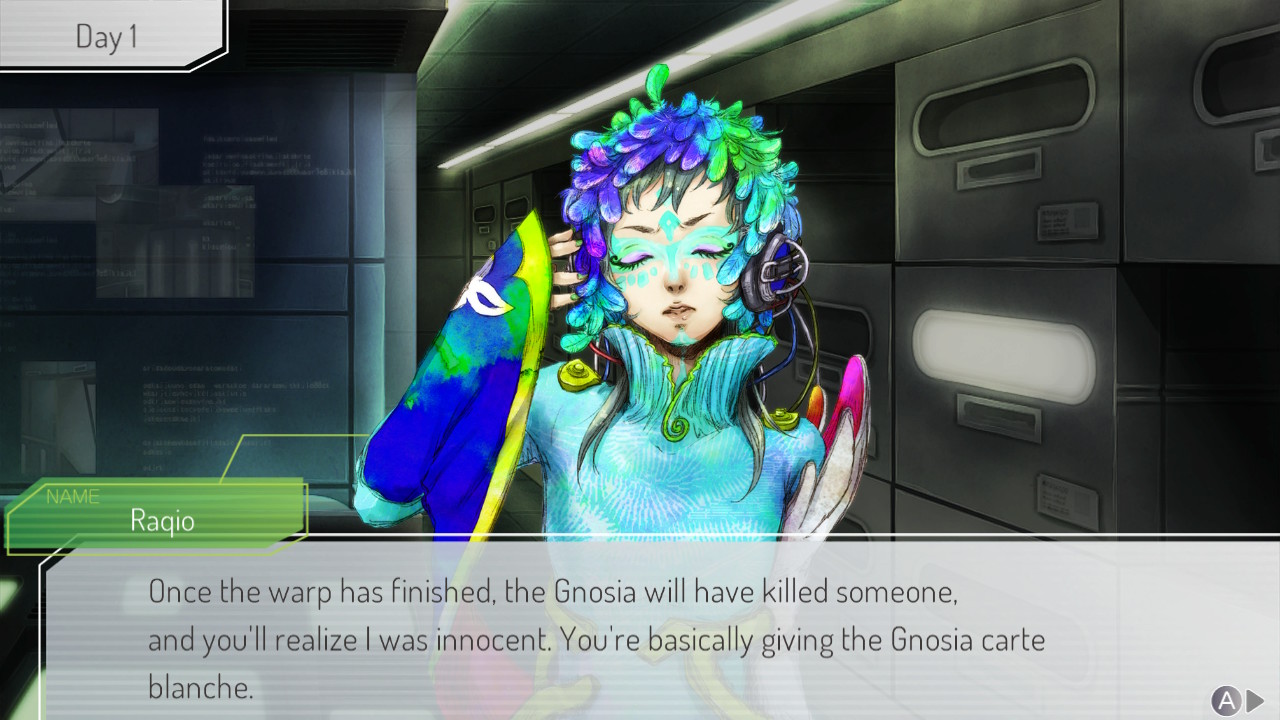
It's made apparent before this point that there's something wrong with the player character. Yuriko calls the MC a distortion and says that they are the reason the Gnosia are on board. Raqio, after being enlightened by Yuriko, notes that the player shouldn't be there. In the game's best twist, we're asked to think about how the ship's AI knew there was Gnosia on board in the first place, to kick off each loop's game of Werewolf. Gnosia presence is detected by someone disappearing, making the MC a first hidden victim just before the start of every loop, but this went unnoticed because the looping version of the MC would loop in right after their disappearance.

Finishing the game involves closing the loop so that the protagonist has a Gnosia-free reality to exist in while not being annihilated by another self, which actually brings the game full circle. Looping is possible because of the Silver Key, an organism that thrives on knowledge (which is why the player needs to learn everything about their crewmates) and once it's full, it can open a portal to another dimension while also disconnecting itself from its host. Setsu is the person who originally gives it to the MC.

To solve the double existence problem, the protagonist (who has finished their Key) opens a portal and Setsu (who has an earlier version of the Key still bonded to them) takes the version of the MC still in recovery through the portal with them, taking the pair to the very first scene of the game. This closes the loop for the protag and also for Setsu who eventually gives their now-finished version of the Silver Key to the protagonist for their very first loop.
It's a bittersweet ending though, since it separates the protag and Setsu, so there is another hidden ending. I don't quite like it as much as a writer, since it breaks continuity, but it was fun as a player. If you start a new game without changing your name and gender from the previous playthrough, the MC wakes up as they usually do at the start of a new game, but instead of the usual answers you can mention something like "Otome fishing," referring to the loop where the MC and Setsu goofed off. Somehow the MC's consciousness jumped dimensions to be with Setsu.

Then Setsu comes up with a plan to save everyone in the first loop, which involves a mind transfer to a doll body and then chucking the Gnosia-now-in-a-doll through a portal with the Silver Key to get rid of her.

While I liked being reunited with Setsu and that this explained the crazy version of Kukrushka in some loops, I didn't buy the protagonist's consciousness crossing dimensions unaided, and that Setsu's Silver Key goes to Manan/Kukrushka since that means it wouldn't have gone to the protagonist to kick off the story. Given all the loops and alternate universes I suppose it's possible that another Setsu gave it to the MC, but the story doesn't seem to work that way. It's pretty clear that it's the same Setsu that the MC encounters each loop, even if they are experiencing the loops in a different order.

Also, there are some questions I had that just never got answers for. For instance, Yuriko says the Gnosia are on board because of the MC, but we never find out how they're connected. Also, the protagonist has/had a version of themselves on board that was erased at the start of each loop, preventing doubling up, but Setsu never has a doubling issue. Why? LeVi, the ship's AI is able to confirm that someone disappeared (the hidden first victim), but not who it was thanks to a memory error/deletion. Who did that and why? It's a little too convenient.
On a final note, this is the first Japanese visual novel I've played with non-binary representation, with not only two nb crew members, but the possibility for the player to be non-binary themselves. I don't know if I experienced any non-binary exclusive content, but the game does recognize genders as I'm aware of male and female-exclusive dialogue around Sha-Ming (who likes women). It's also worth mentioning that Setsu is the most prominent character in the game, including being the protagonist's love interest, and they are non-binary.

Monday, May 17, 2021

May Health Update

It's been about a month since I last posted and my situation has improved substantially. I hesitate to say I'm completely back in action, but I'm in good spirits. It feels strange when people tell me they're surprised by how cheerful I am as I talk about the remainder of my treatment, because to me it's not really that I'm laughing in the face of danger so much as I've resigned myself to what needs to be done and I'm no longer dwelling on it.

I'm still on my feeding tube, and taking in an additional 350 calories a day that way to keep my weight up, but that's much better than it was. I was stuck at taking 700 liquid for a month and for a while I was really frustrated that I couldn't wean myself off a little more, but this past week I finally started gaining weight, so I lowered my intake.

Unfortunately my chemo treatment is probably starting again this week (pending my blood test results), so depending on how I feel, I might need to temporarily bolster my feedings. Chemo makes me nauseous, but on the bright side, the feeding tube goes straight into my gut so in a worst case scenario I don't need to worry about swallowing food.

The current plan is for eight weeks of chemo followed by six weeks of a hybrid chemo/radiation treatment to hopefully kill off any cancer cells that might not have been cut out during surgery. So I'm still going to be in treatment for another three and a half months. I'm not sure yet whether I'll get a break between chemo and chemo/rad. It's so far out I haven't asked.

Aside from that, my neuropathy issues following the surgery are improving. My oncologist said the nerves affected as the same as for carpal tunnel syndrome, so I started wearing a wrist brace to help it heal. I still can't feel temperature out of the first three fingers of my left hand, but the pain spikes are less now and in general my hand feels better when I wake up. Typing is still uncomfortable, but it's a not outright painful to use my left hand anymore.

Monday, April 26, 2021

RPG Talk: Fire Emblem: Three Houses - Blue Lions

In which I talk (write) about RPGs from a storytelling perspective...

Platform: Switch
Release: 2019

Fire Emblem: Three Houses is an ambitious game with three different routes through the first half of the game and four different endings. Honestly, though I'd like to see all of them, a single playthrough is already a very long game, so I don't know that I'll get to all the rest, though at minimum I hope to eventually finish a second route. (Thankfully there is a New Game+ option so a second go-around might not be as time consuming.)

I'm also glad that I finished this before my surgery (and wrote most of this before my surgery) as I'm not sure I would be able to play this in my current state as anything more than a visual novel involves a painful amount of button pressing.

This particular RPG Talk entry will cover both my overall impressions and the Blue Lions route of the game. If I get around to the other routes, they'll have their own entries.

The start of the game introduces the protagonist, Byleth (who can be renamed), and the military academy at the monastery of Garreg Mach. The academy is situated in the middle of the continent of Fódlan, between three nations, who send their best and brightest to be educated there. As it happens, the heirs of the three nations are all in attendance this year and thanks to saving them from some bandits, Byleth and her father are pressed into working for the monastery. Her father, Jeralt, resumes an old position of his as captain of the knights there, and Byleth becomes a teacher.
I'm using female pronouns for Byleth because that's what I used in my playthrough, but the player can choose their gender appearance at the start of the game, and there's a decent case for Byleth being non-binary.

As an instructor, Byleth becomes the head of one of the monastery's three houses, corresponding to each of the three nations. She gets a brief introduction to the students in each of them, and after she makes her selection, the game properly begins.

Though the first half of the game features the same basic storyline for all three houses, many of the scenes will vary owing to having a different cast of characters. It's only after a major event and the five year timeskip that each house spirals out into its own storyline, with the Black Eagles route splitting in two for a total of four possible endings.

When I first heard about the game I was initially going to play the Black Eagles route, but after watching the post-timeskip trailer I ended up falling in love with Dimitri, who I barely recognized from pre-timeskip media. I actually thought he was a major villain at first glance. What could turn such a clean cut teenager into this vengeful man with shaggy hair and an eyepatch yelling to kill them all? There was a story there, and I wanted to see it. So I selected the Blue Lions.
The first half of the game is mostly setup while establishing the weekly routine of life at the monastery, and there is a cadence where each month ends with a battle. Sometimes the battle is narratively something our characters expect well in advance. Other times it's more of a surprise (though to the player it is not since the event is marked on the calendar even though they don't know exactly how it's going to come about).

Things can happen in the middle of the month, but the bulk of the main plot is rendered in the first and last weeks of each month (either setting up or dealing with the result of the month's battle) with the middle likely to be peppered with side quests and optional character development conversations as the students bond with the monastery faculty and each other.

The Blue Lions route focuses mostly on Dimitri, though occasionally other Blue Lion characters will have critical parts to play. As prince of the Holy Kingdom of Faerghus, it's unsurprising that Dimitri's story would take center stage in a game about conflict between the three nations. Whichever house the player chooses to teach is the one Byleth will side with after the timeskip, so playing Blue Lions is really the only way to get Dimitri's story. In contrast, most other students can be recruited into other houses on other playthroughs, allowing their personal side quests to be fulfilled no matter who Byleth sides with.

Dimitri himself starts off as a rather bland character in the fashion of an honorable knight. He's well spoken, kind, and interested in emulating his noble father. But he's had a bad lot for a prince, having both his parents and a good number of his friends violently slain in an event later known as the Tragedy of Duscar. Dimitri himself was the sole survivor.
As the first half of the game passes, it becomes increasingly obvious that despite the appearance of being well adjusted, Dimitri is refusing to let the scars of the tragedy leave him. It's not just a matter of being haunted by the ghosts of his family. He is looking for revenge, and that was his true purpose in joining the academy in the first place. (Though we never learn why he suspected his parents' killer would be in the monastery.)

Dimitri becomes increasingly violent and bloodthirsty when he sees connections between the Tragedy of Duscar and the monastery's enemies until he finally snaps upon confirming that Edelgard of the Black Eagles is in fact the Flame Emperor, one of the main villains of the first half of the game. Despite their history together (they're actually stepsiblings) and Edelgard's insistence she had nothing to do with his parents' death, Dimitri goes off the deep end, and for a good while afterward, can think of nothing but killing her.

And then things get bad.

Edelgard's forces from the Adrestian Empire attack the monastery. During the fighting, Byleth gets knocked out and spends five years in suspended animation, and when she wakes up, she finds out that the entire continent is at war. Edelgard has taken half of the Holy Kingdom of Faerghus, including the capital, thanks to a turncoat noble who framed Dimitri as killing his uncle, the regent. The Leicester Alliance is also troubled by infighting between those who would cave to the Empire and those who wish to fight. And on top of that, Dimitri escaped his execution and has been running around like a madman killing imperial soldiers left and right for the past five years. He is not particularly sane when Byleth runs into him again. In fact he initially mistakes her for another ghost come to torment him for failing them. And this is not a sign of him cracking. He already cracked. He talks to the dead people he's trying to avenge.
It's interesting being put in a position where the leader of the nation is supposed to be a sympathetic character, but the rest of the cast can't trust him to do the right thing. When everyone else reunites after the five year skip, Dimitri is advised to go back to Faerghus, reclaim the capital, and then go to Enbarr, the imperial capital, to take down Edelgard. His advisors want him to be the leader the rest of his country can rally behind, but Dimitri isn't interested in anything except revenge.

This conversation comes up not once, but twice in different circumstances with different characters raising the question. And despite disagreeing with him, the advisors reluctantly stand down and follow his wishes in solidarity with the prince they are honorbound to serve.

I expected a train wreck of a campaign when I picked Dimitri based off his "Kill every last one of them!" line in the trailer, and seeing his obsessive decision making is very much the ride I signed up for. Dimitri himself implies that he no longer cares about the well being of his companions and sees them as tools to be used in pursuit of his agenda.

It almost makes me wonder why some of the characters are still following him, but the thing is, Faerghus has been invaded, half its land stolen, and Edelgard has made it clear that she intends to conquer the entire continent. The rest of the cast might not be happy with Dimitri (Felix in particular makes this known), but they share a common enemy, and it's true that stopping Edelgard should stop the invasion, so he has just enough going for him that people have reason to put up with him.
Following a madman to the bitter end of his quest for revenge is probably a bit too dark for a Fire Emblem game though, so Dimitri does come to his senses, but I'm not entirely sure I like how it happens. He's shown a flagrant disregard for everyone else's safety, so the fact that his father's friend, Lord Rodrigue, dies saving him from an assassin seems an odd choice to snap him out of it.

I suspect the writers wanted Dimitri to reckon with losing another person dear to him, but while that person could still impart some last words that would let him see reason again. The problem is they didn't set it up well enough where we could see why Dimitri would care now when he didn't earlier, and I didn't like that what was written to be mental illness (the voices Dimitri hears are clearly only in his head) is fixed by Dimitri suddenly realizing what an awful person he's been to the living people still around him. He says later that the voices are still there, it's just he's able to avoid listening to them, but his recovery is so clean that if not for that one line of dialogue I would have considered it an inexplicably complete recovery.

Post-timeskip, post-mentally ill Dimitri fits the end to this particular storyline though. He sounds worn and beaten, but determined to do the right thing. He's like his teenage self, but very heavy into atonement and questioning whether he really ought to be king after everything he's done. I suspect that most of his people probably are fine with it, because Dimitri's murder spree over the years has been exclusively at the expense of the Empire. He might have been a mentally ill disaster, but he was their mentally ill disaster, and sticking it to their invaders.
And it's probably best for Fódlan to have a reluctant leader at the end of the day, considering that the Blue Lions storyline eventually results in all of Fódlan coming under Dimitri's rule. The Alliance falls apart from Edelgard's invasion, and the individual lords agree to pledge allegiance to Dimitri, bringing the Alliance back into Faerghus territory (which it originally split off from). Then the Empire falls when Dimitri's army lays siege to it and faces off with Edelgard.

But while I enjoyed the game, the Blue Lions route did not feel fully fleshed out as a story. I understand why we don't get much of Edelgard's motivations, since that will likely be covered in the two Black Eagles routes, but Dimitri's story should have felt complete.

We learn a lot about him, how he cared for his father and stepmother (his own mother dying before he could remember her), and how the Tragedy of Duscar scarred him, but for a backstory defining event, details of the Tragedy are surprisingly light. We know the Duscar people were blamed and had their lands stolen because of it, but we never learn the details about why the Tragedy happened, either the official reason, or the real one.

It's alluded to that Dimitri's stepmother wanted to go back home to the Empire, which was difficult given that she had been chased out of it, and it comes to light that she probably had a hand in the tragedy, which is why her body was never found. That was a great start in building towards a larger conspiracy, but then we never learn anything more. His stepmother is a name without a face, who has no dialogue, and is tied to the traitorous noble who tried handing Faerghus over to the Empire. Characters bring up the fact that it would be extreme for her to murder her current family to go back to her old one, but we never hear her side of the story nor do we know if she ever made it back to the Empire.
This felt like a severe lack of closure since none of this would have happened if not for the Tragedy, and we never learn why Dimitri ties the tragedy to the identity of the Flame Emperor. Though he and Edelgard arguably end the story with no hard feelings towards each other, it doesn't feel earned, especially when we have no idea what happened to the stepmother who wanted to return to her home country and see her biological daughter again. Dimitri doesn't even ask when he has his one chance to see Edelgard on peaceful terms.

I still enjoyed the game, but it was more while the story was playing out than when it finally came to the end and I realized I wasn't going to get the answers I wanted.

Monday, April 19, 2021

April Health Update

I've been home from the hospital for about three and a half weeks now, and though I'm improving, things are still rough. I have a feeding tube in my gut that connects to a feeding pump half the day to make sure I get enough nutrition because I can't eat enough through my mouth right now. But even that is an improvement. I'm making progress. At least the tube isn't necessary 24/7 anymore.

The surgery seems to have gone reasonably well, though I lost all of my stomach. The surgeon tried to save some of it, but it just wasn't in the cards, and after getting my genetic testing back, it looks like taking all of it probably was a good idea. It turns out that I have a genetic defect that predisposes me towards getting stomach cancer, so even if some of my stomach had been saved, I think there would have been a decent chance of the cancer coming back independantly just because my genes suck.

Even though I'm home, I'm still not active much. I can really only do one or two small chores a day, and there have been a lot of times when I've had to make the choice of "Do I write this e-mail or that e-mail?" Because I just can't sit up for very long without getting tired and writing while lying down is not great either. A lot of times things get pushed off to another day, which is why it's taken me longer than I wanted to write about how I'm doing, since I know people have been wanting to know.

It doesn't help that the surgery caused some nerve damage due to my positioning on the operating table. The anesthesiologist and his team were supposed to move my limbs around during surgery to keep the circulation going, but apparently didn't do a good enough job so I woke up with severely numb hands. Though I got the feeling back in them before leaving the hospital, I still can't feel temperature in my thumb and first two fingers of my left hand, and about half the fingers on both hands are overly sensitive to some degree or another which can make it painful to type.

As a writer, this really sucks. And the occasional pain spike in my healing fingers doesn't help. They do seem to be getting better, but really slowly, and from what I'm reading online it may be months before they're fully back.

It looks like my cancer treatment will be changing going forward. My previous round of chemo didn't look like it was that effective, so it sounds like my oncologist may be trying a combination radiation/chemo treatment for my next stretch of treatment. Given that this is a genetic cancer, there might be the possibility of getting into a clinical trial as well.

I'm on leave from work for another month, and I'll probably need it. This is much worse than when I had my endometrial cancer a year and a half ago and the recovery much slower. Though there's a light at the end of the tunnel, it's still very far away.

Monday, March 29, 2021

VN Talk: Our Life: Beginnings & Always

In which I talk (write) about visual novels from a storytelling perspective...

Platform: Windows (also on Mac/Linux/Android)
Release: 2020

I wasn't initially interested in Our Life: Beginnings & Always because I heard about it through otome circles and it's an indie game with a single love interest, which to me screams "railroad" and what if I don't like the guy?

But calling Our Life an otome might be pigeonholing it (and notably the developer refrains from using the term). For one thing, you don't have to be a girl. You get to choose your protagonist's pronouns at the start of the game. For another, having a romance is not required and you can go through the game completely platonic. Our Life is really a game following the life of your protagonist and that of their neighbor, Cove Holden, as they grow from children to adults.

Instead of making a number of choices that culminates in a romance, the player remains in control of their protagonist's feelings and in turn Cove's (whose level of interest will mirror the player's), so the game is only as touchy as you like it to be. The base story takes place over ten years, following the protagonist and Cove from eight to eighteen, and focuses on three summers of their lives.

The player can set the tone for their relationship with Cove at the start of each segment of the game, so it's possible to have love at first sight, or to have a more distant relationship that eventually warms up. My own playthrough ended with them being very close friends, and I'd like to think with romance potential, but not quite crossing that line. This wasn't entirely intentional, but I think it played out nicely enough.

There is a surprisingly long tutorial at the start of the game that is worth reading just because the level of control the player has is unusual, and the player can make adjustments to how they feel about Cove between game segments to show the progression of their relationship.

Despite reading that, I didn't realize the player was intended to change things to reflect how they felt about Cove, so I spent the first two arcs of the story as nervously indifferent because I thought that's what the game was setting it to and my in-game choices pointed to that. (In-game choices do matter and the game will remember a fair number of them from your choice in beverage to how you react to Cove on the day you meet. It's just they won't change your attitude after a timeskip.)

After I figured it out though, I like the system. Because the game crosses over so many years, it's not unexpected that the protagonist's feelings towards Cove might change over time and we're simply not there to witness it. Allowing the player to adjust their feelings lets things change over the years we don't get to see. So even though my protagonist wasn't friends with Cove when they were younger, they eventually become close friends in high school, which is believable as people change over time and circumstances might have placed them a lot closer to each other than when their parents were trying to set up playdates with them.

The choices the player comes across during the game are also widely varied. There are some that likely don't mean anything (what you put on your crepe), others that the game will remember (any dietary restrictions), and some that don't appear to affect the story but simply allow the player to express the kind of person they are (whether or not they accept or offer help). Many times there's also the option to say nothing at all if you want to be the awkward person at a loss for words. Our Life is extremely accommodating so you can self-insert to a large degree without feeling out of character.

One thing I'd really like to mention is that Our Life is incredibly LGBTQIA friendly. The players' parents are two women, referred to as Mom and Mommy/Ma (she changes to Ma after Mommy feels a little too kiddy for their daughters) and the player is free to choose their sexuality and gender identity. I was pleasantly surprised to see that the player also has the option to be trans and deal with gender dysphoria as a teenager, and it's left up to them whether they want to share their sexuality and identity with Cove, regardless of what the player eventually settles on.

Cove himself changes based on his experiences throughout the game (influenced by the player's choices), which likely resulted in the header image I chose for this post. I was really surprised to see him come out as demisexual, which I've rarely seen used in real life or fiction, but it felt completely in character.

Though there isn't really a main plot to speak of, being a series of vignettes that happen over the years, the writing feels pretty realistic for characters no matter which age bracket they happen to be in. Cove at eight feels different from Cove at eighteen, and yet there are parts of his core personality that carry through so you can see that he's still the same person, just grown up.

Because of the lack of a central plot this isn't the sort of game I'd normally play, but it was a pleasant enough ride. If you're in need of something wholesome, where people will ultimately stick together during their troubles, Our Life easily scratches that itch. My only real quibble is that the trailer advertises four summers and fifteen years, but the base game is three summers and ten years. The Step 4 that moves the player and Cove to 23-year-olds will be DLC and probably will not release until the middle of the 2021, based on the developer's comments on Steam.

The base game itself is free though, so one can hardly argue the price! There are also paid DLC packs to add optional additional scenes to the first and second summers (and eventually the third summer as well) for those who would like to support the game further.