The end of March seems a bit of an odd time of year to be doing a Top 10 list, but the last time I did one of these I kept it to a Top 5, and a lot of games have come out in the two and a half years since. While undoubtedly I'll get a few more otome under my belt before the end of the year, I figure this list isn't likely to change too much. And in any case, I tend to feel uneasy about listing something I played too recently, as my love of a game can fade with time, as we'll see one of the games that was previously in my Top 5 has actually fallen.
Moving the number up to ten also gives me space to add a few indie titles, which can't match the production values of a dedicated company willing to shell out for recognizable talent in voice, art, and music.
I'd also like to give honorable mentions to two titles: Hakuoki: Demon of the Fleeting Blossoms, for being my first otome and covering a part of history I find fascinating, and to Bad Apple Wars, for giving second chances to those most willing to fight for it. I thought maybe when I expanded to a Top 10 I might be able to fit them in, but couldn't.
10) Halloween Otome
Halloween Otome is a bit of a sentimental favorite in the English speaking otome community. It was made several years ago when indie projects were much fewer and less often complete. The artwork, while adequate for a free game released nine years ago, would not generate much enthusiasm in today's indie pool, but what I like about Halloween Otome is that it's just sincere fun. Emma Cee is fabulously lucky, and it's worked right into the story as she finds herself with a free ticket to a costume party for the rich and famous. There is no danger. Just people having fun and trying to win a contest put on by their host. The characters are entertaining and it's nice seeing them cameo in the Valentines Otome sequel/spin-off.
You can find this one on the popular indie site Itch.io, and it runs on Windows, Mac, and Linux.
9) My Vow to My Liege
My Vow to My Liege is probably the direct opposite of Halloween Otome, being full of war and betrayal. I wasn't sure exactly where I'd put in the bottom half of my Top 10, but settled on #9 because to be honest, I only really liked half of the love interests. What makes it for me personally is the attention to historical and folklorical detail (once past the part where King Fuchai is actually a younger sister crossdressing as her deceased older brother in order to maintain a hold on her kingdom's power). Fuchai is quite possibly one of my favorite otome protagonists ever. She is king in a time of war and the game lets her do everything a king in ancient times could do, from leading an army to torturing prisoners for information. If you need a more aggressive protagonist than most, Fuchai is your girl.
I believe this one is Windows only, and can be found on Steam.
8) Pre-Odyssey: Odysseus, Penelope, and Her Ducks
The most recent otome on this list in terms of release, I just adored this very sweet and funny story about the courtship of Penelope by Odysseus. It was entirely a one person dev team, so there are rough spots where it shows, but the ducks add a note of levity to what could otherwise be a very serious story, and the nods to the original Greek mythology are top notch. I don't usually talk about the ending credits to a game, or the bonus material, but they're genuinely worth it for this game, since anyone familiar with the mythology knows what happens to these two in the future and the extra material is entertaining commentary from the characters themselves.
The dev also has you covered when it comes to being able to play. Aside from supporting Windows, Mac, and Android, there is a web version that requires no download at all. The game can be found in Itch.io.
7) The Blind Griffin
Though not without its flaws, I think The Blind Griffin is still my sentimental favorite indie, for combining two things I have never see in a game before: 1) being set in the 1920s and 2) starring a Chinese American protagonist. Though the protagonist is player-named, she has her own identity as a Chinese American child from a large family in a time when the Chinese were not particularly welcome. Having come from earlier generations of Chinese immigrants, I knew what sort of history she likely had (for instance, she was more than likely Taishanese, like my own family) and being able to combine that with my general interest in early 20th century history, was pure catnip.
The Blind Griffin can be found for PC, Mac, and Linux on Itch.io.
6) Norn9: Var Commons
The reason I originally justified this in my previous Top 5 is that it emotionally moved me in a way that lower ranked games did not. Norn9 certainly isn't perfect, and the non-romance portion of the plot was a complete mess, but what it did, it did well, and chances are you will like someone in the cast, even if it's not who you originally thought it would be. It's like a bag of jelly beans. You might not like every single bean in the bag, but there are enough of the good ones (assuming you like jelly beans) that it's still worth buying the bag in the first place.
Also, Norn9: Var Commons has now been ported to Switch and in fact is coming out in English this week! So there's no longer a need to own a Vita to play it. The translation has been updated and the fan disk Lost Ark is coming out in English for the first time later this year, so now is a good time to get into the first game.
5) 7'scarlet
Despite being a little light on the romance, I was never not engaged in trying to figure out the mystery of Okunezato in 7'scarlet, and I love a good mystery, but when I looked at its competition I realized that there are a few flaws that really bothered me; mainly the half-baked brother route at the end, but also that there were inconsistencies between routes (such as Sosuke's level of knowledge about the town secrets) that didn't make any sense. I also don't like yandere romance options, though not badly enough that it affects my ranking.
Though this was originally a Vita release, it can be found on Steam where it's often on sale.
4) Collar x Malice
This is the game that probably dropped the most, having been previously at #2. While I did really enjoy the investigation and liked (slightly) over half the romance options, I still don't like the plot problems in Shiraishi's route and even though I bought the fan disk, the longer I go without playing it the more I realize that I'm not quite as in love with it as I originally thought. Still, I really love that Ichika has a social life outside of her interactions with love interests, and especially that she has other women to both hang out with and back her up. It's still a good blend of action and romance that other games don't quite hit.
It originally came out for Vita, but is also available on Switch.
3) Cafe Enchante
I had just gotten Cafe Enchante at the time of my last ranking, so I wasn't sure where it would fall, but after some time and distance I've decided that I really still like it. It's aided by an excellent cast, one of the few where I can say I genuinely liked every guy, including the one I thought I would be ambivalent about. Though it suffers from a lack of quality checking (names are sometimes translated differently, and the dubious translation of "hako oshi" introduced a whole new term to the English speaking fandom), I still like the directions the story was willing to go, making this a surprisingly poignant game by the time I finished.
Cafe Enchante is only available on Switch.
2) Psychedelica of the Black Butterfly
Psychedelica of the Black Butterfly was originally my #3, but was bumped up by the fall of Collar x Malice. It's still not a traditional otome in that the common route (with its own ending) is more or less the canon ending with everything else being either "in addition to" or "instead of," but I love the mystery and the shared story of the cast. The primary characters wake up in a mansion with no memories of how they got there, but the more they learn about their true circumstances, the more painful regaining their memories becomes. Psychedelica of the Black Butterfly gets its placement for having amazing plot twists and a non-linear method of storytelling to show how everything came to be. Romance is much weaker in this game than others due to the nature of it, but it's still a solid game.
Though it was initially released on Vita, it's also been ported to Steam!
1) Code:Realize (series)
And now for my favorite, which is unlikely to be toppled anytime soon, and that is Code:Realize. Spanning three games, Cardia's story of falling in love and finding a way to touch another person without harming them still resonates with me. She's fully capable of facing bad guys with or without her man and the men themselves form a formidable band of friends who work together, so the game is never just a one-on-one with Cardia and a pretty face. Many of the best moments are watching the guys interacting with each other, making them full fledged characters with lives outside the romance, and in turn, that makes the romance better, because when the chips are down it feels like the rest of the cast is 100% behind the couple. They're all friends. Why wouldn't they be? Add in a gorgeous steampunk London, hidden organizations, and the philosopher's stone and you've got quite a combination!
Code:Realize and its sequels were originally released on Vita, but have since come out on PS4 and Switch.
Showing posts with label code: realize. Show all posts
Showing posts with label code: realize. Show all posts
Monday, March 27, 2023

Monday, November 9, 2020
My Top 5 Otome as of 2020

In the meantime, I hope to keep blogging as usual. So even though these posts will keep coming up, there may be a lot going on behind the scenes that you're not seeing.
That said, with last week's release of Cafe Enchante on the Switch, I realized that I'm starting to get backed up on otome games again. I was surprised since I thought I was putting a fair dent in my backlog, but it's mostly that my Vita backlog is dwindling, since Period Cube and Psychedelica of the Ashen Hawk are the only ones that remain of that generation. Switch is probably going to be the new home of backlog, as I already had Collar x Malice Unlimited waiting for me.
So I realized; otome has been out long enough that I've played a fair number now, and the English language audience has grown, from dozens of indie studios making PC games to a gaggle of mobile titles. I actually could put together a list of my favorites and it wouldn't simply be every game I've played.
This Top 5 list might be a bit biased, because quite frankly they're all Otomate titles, but Otomate also has the budget for art, voice acting, and sheer length of story that most indie studios can't match. It doesn't hurt that nearly every Otomate title that has an English translation has also been released by Aksys on consoles/handhelds, where there is minimal competition, especially in the realm of physical releases.
Without further ado, here's my Top 5:
5) Norn9: Var Commons
I had to think about this one. There were other runners-up, particularly indie titles Halloween Otome and The Blind Griffon, but when I thought about it, though those two indies were really fun, I wasn't emotionally moved the way I was with certain routes of Norn9. Norn9 certainly wasn't perfect, but what it did, it did well, and chances are you will like someone in the cast, even if it's not who you originally thought it would be. It's like a bag of jelly beans. You might not like every single bean in the bag, but there are enough of the good ones (assuming you like jelly beans) that it's still worth buying the bag in the first place.
Unfortunately, Norn9 was only ever released in the US on the PS Vita, so if you don't have the hardware, you're out of luck.
4) 7'scarlet
There's a part of me that's shocked 7'scarlet comes in at #4 because I really loved the mystery and how the supernatural lore unfolded with the completion of every route. I was never not engaged in trying to figure out the mystery of Okunezato for myself, but when I looked at its competition I realized that there are a few flaws that really bothered me; mainly the half-baked brother route at the end, but also that there were inconsistencies between routes (such as Sosuke's level of knowledge about the town secrets) that didn't make any sense. I also really don't like yandere romance options, and Isora tilts that way, though not badly enough that it affects my ranking.
Non-Vita gamers are in luck with this one, as it's also available on Steam.
3) Psychedelica of the Black Butterfly
This one is not a traditional otome in that the common route (with its own ending) is more or less the canon ending with everything else being either "in addition to" or "instead of." But since it's marketed as otome, I'm putting it here. As with 7'scarlet, I love the mystery elements of the story. The primary characters wake up in a mansion with no memories out how they got there, but the more they learn about their true circumstances, the more painful regaining their memories becomes. Psychedelica of the Black Butterfly gets its placement for having amazing plot twists and a non-linear method of storytelling to show how everything came to be. Romance is much weaker in this game than others due to the nature of it, but it's still a solid game.
Though it was initially released on Vita, it's also been ported to Steam!
2) Collar x Malice
There's a part of me that thinks I should have switched this with Psychedelica of the Black Butterfly, but Collar x Malice is pretty clearly an otome with more emphasis on the romance even though the player is also hunting down criminals with the help of a cop and/or private detectives. I really love that Ichika has a social life outside of her interactions with love interests, and especially that she has other women to both hang out with and back her up. The blend of action and romance was pitch perfect in this one. What prevents me from ranking it higher is the X-Day methodology on Shiraishi's route (which makes no sense compared to the other routes) and that I actually didn't like Shiraishi or Okazaki that much, and having two of five love interests not work for me was a little high.
This was originally a Vita release, but has since been ported to Switch. And the fan disk is out in English as well, though I haven't played it yet. If it's good enough, it might even change my mind about Shiraishi and Okazaki.
1) Code:Realize ~Guardian of Rebirth~
Okay, if you know me, the #1 pick wasn't going to be any surprise. I adore the Code:Realize series. Cardia is a lovely protagonist who grows over the course of the game. She's fully capable of facing bad guys with or without her man and the men themselves are a wonderful cast of characters. The group of them form a band of friends who work together, so the game is never just a one-on-one with Cardia and a pretty face. Many of the best moments are the guys interacting with each other, making them a full fledged cast of characters with lives outside the romance, and in turn, that makes the romance better, because when the chips are down it feels like the rest of the cast is 100% behind the couple. They're all friends. Why wouldn't they be? Add in a gorgeous steampunk London, hidden organizations, and the philosopher's stone and you've got quite a combination!
Code:Realize and its sequels were originally released on Vita, but have since come out on PS4 and Switch, with the exception of ~Wintertide Miracles~ on Switch, which isn't due until early 2021.
Monday, February 3, 2020
My Favorite Games of 2019
I'm getting better at not buying more games than I can consume in a year, but I still play the occasional free-to-play indie title and wind up with a number of commercial games through promotional giveaways. The result is that I rarely play any game in its year of release unless it's a part of a favorite series, and even then, depending on how busy I am, a much anticipated game might get postponed.
These are the 12 games I liked enough to finish for the first time in 2019, in the order I played them. If the game is available on multiple platforms, the one I played on is listed first. My top three picks of the year are marked with an asterisk (*).
Doki Doki Literature Club (Windows, Mac, Linux)
This is an excellent pay-what-you-want indie title that has been sitting in my backlog for a while. It was really popular in 2017, but never got close to the top of my list due to the fact I play a lot of visual novels and visually DDLC fell out of my usual genre preferences, even though I knew there was a twist. Despite its cheerful appearance, there's a not suitable for children or those easily disturbed warning for a reason (specifically those suffering from anxiety and depression). The less you know the better it's supposed to be, but if you want to be spoiled there's also my VN Talk write-up for the game.
Etrian Odyssey II: Heroes of Lagaard (DS, remade as Etrian Odyssey 2 Untold: The Fafnir Knight on 3DS)
The Etrian Odyssey series is made for people have a fondness for old school dungeon mapping; the kind you do on paper. This is a game out of the unfinished backlog where I started it years ago and abandoned it. As dungeon crawlers go though, I like the EO series for providing us with lush, natural looking dungeons; non-traditional monsters; and an interesting variety of classes to build a party out of. EOII introduces an additional healing class which is nice, and expands a bit on the late game twist from the first EO, but otherwise doesn't have much in the way of twists itself. Overall I think I like the first game better, but the second isn't bad.
Code:Realize ~Wintertide Miracles~ (PS Vita, PS4) *
This is the second fandisc in the Code:Realize otome series. Though it came out on Valentine's Day in the US, it's actually Christmas themed. Most of its content is alternate universe material based off of the Finis route in ~Future Blessings~ and will expect you to have played the previous games, but that said it's an excellent send-off to your favorite characters and well worth it if you enjoy the franchise. Those love interests who didn't already have weddings in their original timelines, finally have them here as bonus epilogues.
The Liar Princess and the Blind Prince (PS4, Switch) *
Liar Princess plays like an indie puzzle platformer, though it comes from a more established Japanese publisher. A wolf accidentally blinds a prince who was trying to catch a glimpse of her while she was singing, and to make up for her mistake, the wolf gives up her voice to take on a human shape. She pretends to be a princess from a neighboring kingdom so she can guide the prince to a witch who can restore his sight, but along the way she has to take pains to hide who she truly is out of fear the prince would call her a monster. The story is very sweet and a little sad, and the art design is fantastic.
We Were Here (Windows, Mac, Linux)
A friend and I played this on a whim since it's a two player co-op puzzle-solving game along the lines of real world escape rooms, and it's free to play. Both players are separated and have to work together to solve clues that will enable them to be reunited. There are no jump scares, but the atmosphere is definitely on the side of creepy. It's possible to get game overs in a few places if you take too long, but the game has several checkpoints so you'll never be more than a quick puzzle away from where you failed. We Were Here took my friend and I about two and a half hours to get through and it was a fun way to spend an evening, especially if you like puzzles and escape rooms. You do need voice communication though, so if you're not playing in the same room you'll need a mic and the game comes with voice chat capabilities.
Divinity: Original Sin (PC, PS4, XB1)
I'd been hankering for a good party-based western RPG in the void of waiting for another Dragon Age, and though the worldbuilding took me a little time to get into, the game itself is pretty fun, though a bit merciless. It's turn-based, which is an oddity in this day and age. Each move takes a certain number of action points and each character gets a certain amount a round. Feels very table-top. The story is serviceable, but hampered by pacing issues. The dual protagonists are what the player makes of them, and I'd advise having some personality conflicts between them to bring out the more engaging banter. I played the Enhanced Edition which added additional quests and reworked some of the story (including the ending).
Persona 3 Portable (PSP, versions without female protagonist also on PS2)
Persona 3 Portable is the only version of Persona 3 to have a female protagonist option, and game is substantially different for it. All the Social Links have been redone, so even though the dungeon delving and overall plot is much the same as the original male playthrough, there's a lot of new secondary content and tons of VO has been rerecorded to change pronouns to match to the protagonist's gender on the female route. I can't imagine how much work that was, since English is so heavily pronoun dependant, but Atlus really went the extra mile, and I'm grateful. I actually had this game sitting partially completed for years, but just went back to it so I could finish before I played Persona Q2, which features the return of the female protagonist.
Bad Apple Wars (PS Vita)
If you like otome and have a Vita, this is a solid afterlife romance with no locked characters and is completely yandere free. (Which I consider a plus.) The art might not be as pretty as some, and there are a couple questions the game never answers, but I like the way it chooses to integrate romance-specific scenes into the common storyline so it feels natural rather than having the player bumble around trying to score points with a particular bachelor. In most cases, you have to work to get a bad ending. Showing up at all of a love interest's color coded scenes and not hurting him during late game Soul Touches is pretty much all you need to do to get the best endings, and the in-game flowchart makes it incredibly easy to revisit old scenes.
Final Fantasy XV (PS4, XB1, Windows) *
I went into this game with fairly low expectations, having bought it due to all the memes and a really good Christmas sale. Mark me surprised. This ended up being my second favorite Final Fantasy of the four I've played. It's not a perfect game, not by a long shot, but what it does well, it does really well, which is specifically the friendship between Noctis and his companions. The first half of the game is ridiculously open world just as the second is ridiculously linear, but oddly enough, the second half wouldn't work as well if all the free time in the first half didn't exist. It's a difficult issue to resolve from a gameplay standpoint, but I respect the gamble taken.
Death Road to Canada (Switch, PS4, XB1, Windows, Mac, Linux, iOS, Android)
This game boils down to being a more actiony, violent version of Oregon Trail. Instead of heading for Oregon, you and your buddy (or buddies since up to four people can play) are stuck in a zombie-filled America and you have to ration your supplies and scavenge for more as you head for the only safe country left; Canada. Like Oregon Trail, gameplay is a mix of random events, choices you have to make, and careful management of your resources. Something is going to go wrong along the way, and sometimes you'll die, but playthroughs are short enough that it's easy to just try again.
Persona Q2: New Cinema Labyrinth (3DS)
This is one of those games that's not going to make sense to anyone unless they've played at the bare minimum Persona 5, but really, you'll get the most joy out of it if you've played Persona 3 and 4 as well. For people who've missed the female protagonist from Persona 3 Portable she's back and gets a ton of face time. It's a little bizarre thinking of a cast of 28 characters rolling through a dungeon all at the same time, but everyone gets to weigh in on everything even if they're not currently in the active party. It might not be realistic, but this game primarily exists as fanservice, so some break in reality is acceptable and even welcome.
Sherlock Holmes: Crimes and Punishments (Windows, PS3, PS4, X360, XB1)
I'm not a diehard Holmes fan, but I do love myself a good detective game. Controls are a bit wonky for someone unused to FPS games, but the mystery-solving is good and I like that the game lets you make the jump from evidence to answers without necessarily confirming whether you are right. The possibility of getting it wrong and allowing the game to continue after you do, adds a little edge that other mystery games lack. It won't affect later cases, but it's nice not being forced to replay segments in the game until you follow the logic a developer had in mind. I would have liked this one more if two of the casess weren't hard to solve due to dubious logic or misleading dialogue from Holmes himself.
These are the 12 games I liked enough to finish for the first time in 2019, in the order I played them. If the game is available on multiple platforms, the one I played on is listed first. My top three picks of the year are marked with an asterisk (*).
Doki Doki Literature Club (Windows, Mac, Linux)
This is an excellent pay-what-you-want indie title that has been sitting in my backlog for a while. It was really popular in 2017, but never got close to the top of my list due to the fact I play a lot of visual novels and visually DDLC fell out of my usual genre preferences, even though I knew there was a twist. Despite its cheerful appearance, there's a not suitable for children or those easily disturbed warning for a reason (specifically those suffering from anxiety and depression). The less you know the better it's supposed to be, but if you want to be spoiled there's also my VN Talk write-up for the game.
Etrian Odyssey II: Heroes of Lagaard (DS, remade as Etrian Odyssey 2 Untold: The Fafnir Knight on 3DS)
The Etrian Odyssey series is made for people have a fondness for old school dungeon mapping; the kind you do on paper. This is a game out of the unfinished backlog where I started it years ago and abandoned it. As dungeon crawlers go though, I like the EO series for providing us with lush, natural looking dungeons; non-traditional monsters; and an interesting variety of classes to build a party out of. EOII introduces an additional healing class which is nice, and expands a bit on the late game twist from the first EO, but otherwise doesn't have much in the way of twists itself. Overall I think I like the first game better, but the second isn't bad.
Code:Realize ~Wintertide Miracles~ (PS Vita, PS4) *
This is the second fandisc in the Code:Realize otome series. Though it came out on Valentine's Day in the US, it's actually Christmas themed. Most of its content is alternate universe material based off of the Finis route in ~Future Blessings~ and will expect you to have played the previous games, but that said it's an excellent send-off to your favorite characters and well worth it if you enjoy the franchise. Those love interests who didn't already have weddings in their original timelines, finally have them here as bonus epilogues.
The Liar Princess and the Blind Prince (PS4, Switch) *
Liar Princess plays like an indie puzzle platformer, though it comes from a more established Japanese publisher. A wolf accidentally blinds a prince who was trying to catch a glimpse of her while she was singing, and to make up for her mistake, the wolf gives up her voice to take on a human shape. She pretends to be a princess from a neighboring kingdom so she can guide the prince to a witch who can restore his sight, but along the way she has to take pains to hide who she truly is out of fear the prince would call her a monster. The story is very sweet and a little sad, and the art design is fantastic.
We Were Here (Windows, Mac, Linux)
A friend and I played this on a whim since it's a two player co-op puzzle-solving game along the lines of real world escape rooms, and it's free to play. Both players are separated and have to work together to solve clues that will enable them to be reunited. There are no jump scares, but the atmosphere is definitely on the side of creepy. It's possible to get game overs in a few places if you take too long, but the game has several checkpoints so you'll never be more than a quick puzzle away from where you failed. We Were Here took my friend and I about two and a half hours to get through and it was a fun way to spend an evening, especially if you like puzzles and escape rooms. You do need voice communication though, so if you're not playing in the same room you'll need a mic and the game comes with voice chat capabilities.
Divinity: Original Sin (PC, PS4, XB1)
I'd been hankering for a good party-based western RPG in the void of waiting for another Dragon Age, and though the worldbuilding took me a little time to get into, the game itself is pretty fun, though a bit merciless. It's turn-based, which is an oddity in this day and age. Each move takes a certain number of action points and each character gets a certain amount a round. Feels very table-top. The story is serviceable, but hampered by pacing issues. The dual protagonists are what the player makes of them, and I'd advise having some personality conflicts between them to bring out the more engaging banter. I played the Enhanced Edition which added additional quests and reworked some of the story (including the ending).
Persona 3 Portable (PSP, versions without female protagonist also on PS2)
Persona 3 Portable is the only version of Persona 3 to have a female protagonist option, and game is substantially different for it. All the Social Links have been redone, so even though the dungeon delving and overall plot is much the same as the original male playthrough, there's a lot of new secondary content and tons of VO has been rerecorded to change pronouns to match to the protagonist's gender on the female route. I can't imagine how much work that was, since English is so heavily pronoun dependant, but Atlus really went the extra mile, and I'm grateful. I actually had this game sitting partially completed for years, but just went back to it so I could finish before I played Persona Q2, which features the return of the female protagonist.
Bad Apple Wars (PS Vita)
If you like otome and have a Vita, this is a solid afterlife romance with no locked characters and is completely yandere free. (Which I consider a plus.) The art might not be as pretty as some, and there are a couple questions the game never answers, but I like the way it chooses to integrate romance-specific scenes into the common storyline so it feels natural rather than having the player bumble around trying to score points with a particular bachelor. In most cases, you have to work to get a bad ending. Showing up at all of a love interest's color coded scenes and not hurting him during late game Soul Touches is pretty much all you need to do to get the best endings, and the in-game flowchart makes it incredibly easy to revisit old scenes.
Final Fantasy XV (PS4, XB1, Windows) *
I went into this game with fairly low expectations, having bought it due to all the memes and a really good Christmas sale. Mark me surprised. This ended up being my second favorite Final Fantasy of the four I've played. It's not a perfect game, not by a long shot, but what it does well, it does really well, which is specifically the friendship between Noctis and his companions. The first half of the game is ridiculously open world just as the second is ridiculously linear, but oddly enough, the second half wouldn't work as well if all the free time in the first half didn't exist. It's a difficult issue to resolve from a gameplay standpoint, but I respect the gamble taken.
Death Road to Canada (Switch, PS4, XB1, Windows, Mac, Linux, iOS, Android)
This game boils down to being a more actiony, violent version of Oregon Trail. Instead of heading for Oregon, you and your buddy (or buddies since up to four people can play) are stuck in a zombie-filled America and you have to ration your supplies and scavenge for more as you head for the only safe country left; Canada. Like Oregon Trail, gameplay is a mix of random events, choices you have to make, and careful management of your resources. Something is going to go wrong along the way, and sometimes you'll die, but playthroughs are short enough that it's easy to just try again.
Persona Q2: New Cinema Labyrinth (3DS)
This is one of those games that's not going to make sense to anyone unless they've played at the bare minimum Persona 5, but really, you'll get the most joy out of it if you've played Persona 3 and 4 as well. For people who've missed the female protagonist from Persona 3 Portable she's back and gets a ton of face time. It's a little bizarre thinking of a cast of 28 characters rolling through a dungeon all at the same time, but everyone gets to weigh in on everything even if they're not currently in the active party. It might not be realistic, but this game primarily exists as fanservice, so some break in reality is acceptable and even welcome.
Sherlock Holmes: Crimes and Punishments (Windows, PS3, PS4, X360, XB1)
I'm not a diehard Holmes fan, but I do love myself a good detective game. Controls are a bit wonky for someone unused to FPS games, but the mystery-solving is good and I like that the game lets you make the jump from evidence to answers without necessarily confirming whether you are right. The possibility of getting it wrong and allowing the game to continue after you do, adds a little edge that other mystery games lack. It won't affect later cases, but it's nice not being forced to replay segments in the game until you follow the logic a developer had in mind. I would have liked this one more if two of the casess weren't hard to solve due to dubious logic or misleading dialogue from Holmes himself.
Monday, June 24, 2019
VN Talk: Code:Realize ~Wintertide Miracles~ - Part 9: Cantarella

Sorry for another bobble in my posting schedule. Things have been a bit rough lately, and I'll try to address that in my next post, since I'd really like to finish up my Code:Realize ~Wintertide Miracles~ write-up first. But I will say that if you've been enjoying my VN Talk series to please consider dropping a tip in the Ko-fi jar, which you'll see in the upper right of my blog.
That said, this is the last, but certainly not least, of the ~Wintertide Miracles~ stories.

It's a story about fathers and daughters and it's much better done than the Lupin's Gang side story in ~Future Blessings~. Lupin's Gang wasn't bad, but it clearly a side story unrelated to the main plot, and it didn't handle its father/daughter pairing with nearly the same deftness that Cantarella does.
In fact my biggest complaint with Lupin's Gang was that Shirley's father gave the final punch to the villain, taking away from Shirley's previous moment of victory and making the finale a showdown between two dudes, neither of whom the audience really cares about.
Like Lupin's Gang, Cantarella takes place after the airship race, but before Cardia and friends discover Isaac's laboratory, and from there dances a careful game between what the audience knows and what the main cast knows. Unlike Lupin's Gang, this does not take place completely outside the main storyline, and weaves in familiar enemies and even a familiar backstory.

Miles is introduced as a lazy layabout who gambles away all of Cantarella's earnings (save what she needs for medication--he's pretty adamant he would never go that far) and from his looks, it's pretty obvious that he's not old enough to be her biological father. Though Cantarella's often frustrated with him, she tells Cardia about how Miles found her gravely injured as a child and took her in. They started calling themselves father and daughter because there could be no other reasonable explanation for a man to be living with a young girl, but Cantarella always calls him "Miles" because she's not sure how well he'd take to being called "Father" and she's afraid of being rejected, and with good reason.

We also learn that Miles used to be the second-in-command of Twilight, so naturally he knew something (though not all) of Isaac's research, and became horrified when he was introduced to the room full of Cardia clones. This led to him becoming disaffected from his job and when he finally went AWOL, he spotting a dying clone and took her with him, naming her Cantarella.
(Which, by the way, only works because apparently nobody in Code:Realize knows the story of the Borgias. Miles named his daughter after a poison, which given that she's a Cardia clone is appropriate, but not something he should be advertising to the world.)
This means that Cantarella is actually Cardia's older sister. And by basing Miles's backstory around Twilight, the story is able to make use of Aleister and Twilight itself as part of the plot. Since Cantarella was artificially created and Isaac seemed to have implanted something in her brain, Miles needs Zicterium to treat it, and Twilight's the only source of that in town. Miles has been paying them Cantarella's earnings to get a regular supply, but now that Cardia's in the picture, Aleister has a different sort of payment in mind; one that Miles can't refuse.

I mentioned how Cardia meets Cantarella due to Baron Aiguille trying to kidnap her. Baron Aiguille is a completely unrelated party who has "inherited" a moving castle that won't walk anymore because it lacks the voiceprint of the appropriate singer to make it move. It's implied the castle was built by Isaac, and given that he knows it will no longer move but the appropriate person may eventually be born who will be able to wake it, it was probably something he'd built for the real Cardia and then buried knowing that eventually the reborn one might be able to reclaim it.
Aiguille is a fun character even though he comes off as a bit of a brute in his introduction. He's arrogant, and shows up in a hilarious variety of places. The player gets to choose where to hang out with Cantarella soon after meeting her, and there are five locations (so each love interest has an opportunity to tag along). I highly recommend reloading repeatedly to do all of them. Even though a lot of the dialogue between Cantarella and Aiguille ends up rehashed I love how he randomly turns up in his mask and carnival costume in public as if it's no big deal and there's always a context specific question about why people don't mistake him a robber or the like.
One thing I love about Cantarella is that she has a really sharp tongue. She uses it on Miles a lot, and she certainly doesn't spare Aiguille. When he tries calling her his Fairy Tale Songstress, she doesn't have any of it, and won't even respond to his loony threats until he finally gives in and properly calls her by her name. Cardia and her male companion generally comment on how it doesn't even look like the conversation is happening between kidnapper and kidnappee.

At this point, I really wasn't sure where the story was going, since the two plots were so different from each other. There's a fairy tale we're given early on about a paraplegic prince and a singing princess who are given a moving castle so the prince can see the world, and from the accompanying drawings, the prince and princess are clearly supposed to be Aiguille and Cantarella, but the two of them don't actually have a shared history and this fairy tale actually exists in their world so it would be weird if their lives were exactly as the fairy tale depicted.
Fortunately that's not the case. We finally meet the real Aiguille, who is not entirely paraplegic, but has "bad legs." Apparently he can walk a little bit with a cane, but it's very difficult for him so he usually goes around in a sort of automated wheelchair. I do like that Code:Realize has a prominent disabled character in the story, and depending on the choices made he might even get a big moment to save the day, but I'm not sure whether I like the ending where they mention he's training to walk better. It seems like if it was possible for him to regain his ability to walk (he lost it in a childhood illness) he would have done so years ago. Worse, it implies that the reason he hasn't been able to walk is that he's been too lazy to rehabilitate himself.

Of course, being that this is an invention of Isaac's (especially if you play this after the Finis epilogue) it's not entirely unexpected when things go horribly bad. The castle powers up and sucks Cantarella into its main hub where the device in her brain goes into overload with leftover commands from Isaac. In anguish and having flashbacks of being discarding, Cantarella continues singing, because she wants to please her father and knows that's what is being asked of her, and her dirge turns the castle into an uncontrollable monstrosity that powers straight for London.
This sets up the finale where Miles comes clean about what he was really doing with Twilight, so he can accompany Lupin and friends on the rescue mission to the castle, where they met up with Cardia and Aiguille and everyone heads for the main hub to rescue Cantarella.

It packs an incredible heft to it, especially considering that much of Code:Realize has already been about children and their fathers, particularly Isaac in regards to his creations. But unlike Isaac, Miles truly cares about Cantarella as a human girl and not a homunculus or lab experiment.
This is the finale, and not anything that has to do with Aiguille other than the fact the trigger for Cantarella's device happens to be a part of his castle. I really liked the father-daughter relationship, and the fact we've come to care about both Cantarella and Miles makes this work. Though we're only with them for a few hours, both of them are fully realized characters with their own fears and foibles by the end of the story.
What I didn't particularly expect to find in this side story though, was the rehabilitation of a minor, previously unnamed character, now known as Theophraste. This is Lupin's mentor.
As we learned in Lupin's ~Guardian of Rebirth~ route, his mentor was previously a Twilight operative, and from Miles's backstory we discover that the two of them were close friends and found out about the Cardia clones at the same time. Apparently in Twilight's early days, before it became a full-on secret agency, Theophraste was able to convince himself that even if he got his hands dirty, he was doing it for the greater good, and some of his sense of justice rubbed off on the more cynical Miles. But learning about the Cardia clones broke both of them, because there was no way any of those girls could be related to protecting the British people. Being in charge of intelligence, Theophraste arguably had it worse, as he knew exactly what Isaac's plans were.

Though this tie-in worked for me initially, it doesn't hold up under scrutiny. The problem is that Lupin says in ~Guardian of Rebirth~ that he met his mentor when he was about ten. According to the official artbook, Lupin is 24 at the start of the game, meaning that they met fourteen years ago. But according to Miles, he and Theophraste didn't freak out and leave until six years ago. When they go through the lab for Isaac's documents, most of the specimens are already dead or disposed of. The successful Cardia is not there, which matches the timeline given in ~Guardian of Rebirth~, which places her in Wales six years prior to the story.
I suspect that someone forgot (or decided to ignore) that Lupin's backstory can't be reconciled with the new information in Cantarella. Even if we ignore his age in the artbook, Lupin's young enough in the flashback image that he's probably no older than his early teens when his mentor dies, and this is a man he's described as raising him, so they'd obviously been together for some years prior.
One thing that I'm a little surprised about is that we never learn Miles's birth name. One of Miles's flashbacks mentions that is not his real name, which makes sense being that he's an intelligence agent, but we're only left with implications as to his real identity, rather than it being spelled out at any point. This means that only lore nerds are likely to guess that he is actually Mycroft Holmes.

I can understand not wanting to spell it out in Sholmès's route since there's no way of knowing the order the player will go through the different stories and explaining why Mycroft is going by Miles in the opening credits would get needlessly complicated, but at least in the Cantarella story it should have been okay to call him Mycroft at some point. Sholmès doesn't show up, but the players already know that Sholmès is Sherlock Holmes and he's been a major character in the past so there would be less explanation needed.
Cantarella was unexpectedly the highlight of ~Wintertide Miracles~, which makes me a little sad that there isn't anything left in the main story to explore, since I very much would like to spend additional time with Cantarella and Miles. There are no additional fandiscs after this, and the two don't appear in the unlockable Special Epilogues, which is a shame. This side story is a real gem, and I expect to go through it again in the future.
Monday, June 10, 2019
VN Talk: Code:Realize ~Wintertide Miracles~ - Part 8: Finis

This week I'm covering Finis's route for Code:Realize: ~Wintertide Miracles~. Please beware of spoilers if that concerns you as I'll be discussing everything including the ending.
When I started, I wasn't immediately sure where Finis's story was going, because he's a non-romantic route and while it's nice seeing him and Cardia establish a relationship as siblings, we already get a lot of that in the Christmas stories with the other characters. At first glance, living their happy ending feels like all there is.
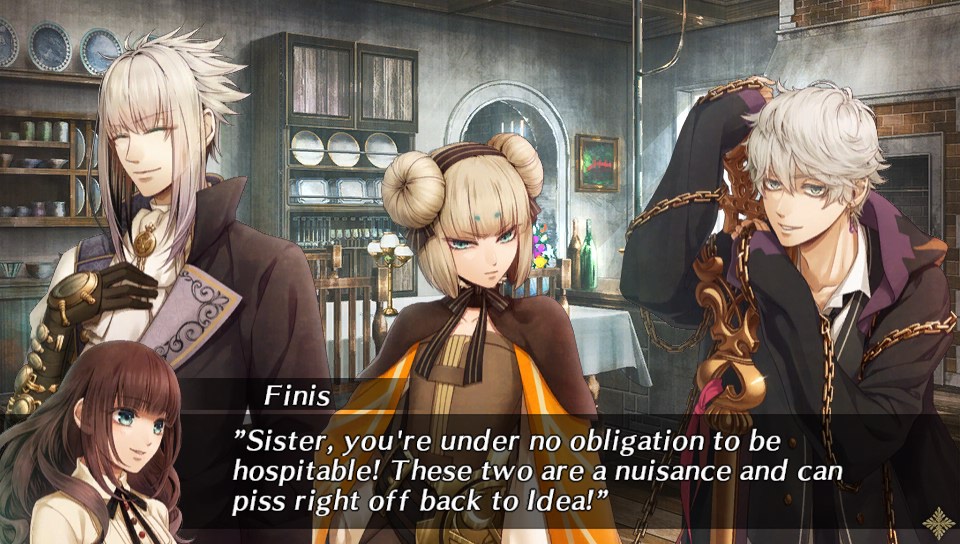
We also get cameos from Sholmès and Watson, who are pursuing Moriarty/Aleister, who happens to stop by the Beckford manor to ask a question of Finis, his former boss. It's an excuse to show how Finis has changed, as he's willing to share his new outlook on life with Aleister (though he's too embarrassed to admit any of those feelings to his sister), but it's also a reminder that even though Finis has left his old life as the head of Twilight behind, he's still Isaac Beckford's creation.
And that's really where the story takes a much different tack than the rest of the stories in ~Wintertide Miracles~.
The remaining stories have a low level of danger, but in Finis's epilogue, London experiences a mysterious disaster that is causing buildings to collapse. Cardia and Finis aren't sure what's going on at first, being so remote that their local newspaper doesn't have the details, but they want to help, and that's when Idea steps in, in the form of Hansel.

We get to see cameos of the other characters since Lupin and company are obviously not going to stand idle while what turns out to be giant machines are wrecking London, and there are some good jokes about why a construction robot needs a cannon mounted on it (other than it makes for a menacing enemy!). Though this ultimately ends up being more of Finis's story than anyone else's, Cardia gets some really good moments.
Cardia is the one who thinks of getting Impey's ornithopter to head off the master robot, and she's the one who both pilots it and drops the bombs. While this feels well within anything Cardia does, it's sadly still refreshing to see an otome heroine this dynamic.
But it's Finis who jumps out of the ornithopter to land on the robot's head so he can get to the control panel and halt its commands to the other robots. We get to see Finis at his most vulnerable, when he hesitates to complete the command input. It's not because he is missing part of his father's knowledge, as Hansel suspects, but that he's saddened by the fact he has to destroy even more of his father's legacy. And if that's not enough, when he finally keys in the passcode, it's "my_dearest" as a reminder that Isaac Beckford had done everything to be reunited with his family.

After the credits roll we're treated to a congratulations party for Finis, who has returned to work for the government to properly handle Isaac's legacy (no more malfunctioning giant robots). Idea's approved of his new work, so long as Hansel is part of the new Daybreak bureau for oversight, and Cardia happily announces to him that they're getting a new family member.
Given that this is a romance game, and Finis is all too aware that most of Cardia's companions are male, he immediately jumps to thinking she's getting married, but it's actually that the dog Sisi is joining their household so Cardia has someone to keep her company while Finis is at work. To be honest, I figured it was the dog, since the game wouldn't shoehorn in a canon love interest on a route where the player makes zero choices, so I pretty much stayed back and enjoyed Finis going around accusing various guys of impropriety or pondering whether they would try at all. Amusingly he dismisses Impey without even considering that he could be a candidate.
Other than the fact there are zero choices to be made on this route, I quite enjoyed it and would have liked to see what kind of future it would lead to. It's a bit odd that despite taking place six months after ~Guardian of Rebirth~ there is no snow, since temporally that places it concurrent with the Christmas stories, but I assume that was done to dodge the Christmas romance themes in the other routes.
Next week will be the last installment of VN Talk for ~Wintertide Miracles~, covering the Canterella side story, which I have to say is excellent.
Monday, June 3, 2019
VN Talk: Code:Realize ~Wintertide Miracles~ - Part 7: Sholmès

This week I'm covering Sholmès's route for Code:Realize: ~Wintertide Miracles~. Please beware of spoilers if that concerns you as I'll be discussing everything up until the ending.
I have to admit that when I started Sholmès's epilogue it forced me to realize that I don't really remember the details of his ~Future Blessings~ route all that well. I remember the basic gist of his story with Moriarty/Aleister and how Cardia ended up at his house, but the epilogue opens with Sholmès reflecting on his relationship with Watson and how Mary ended up getting killed, and that was a detail I didn't remember all. I remembered that Watson's wife had died before the Sholmès route began, but couldn't recall exactly what Sholmès had done to contribute to to it, and his musings do nothing to refresh my memory.
I also hadn't liked Sholmès's route much due to heavily borrowing plot elements from Van Helsing's storyline, including the villain himself. Unfortunately he doesn't fare much better in his After Story either.

We get to see cameos of other members of the main cast (everyone except Saint-Germain really) and of course Victor gets involved again. He and Watson are working on trying to develop a cure for Cardia, but there's no Zicterium for him to work with this time, so thankfully the game avoids shoehorning Victor's ~Guardian of Rebirth~ solution into yet another After Story.
Sholmès himself is rather useless this route since he can't personally do anything to help Cardia except cheer her on since he's a detective, not a scientist. But he does a fair enough job of wining and dining her, and he does run into a convenient contact, who leaves him with a potion identical to the one used by the Count of Monte Cristo that will leave someone in a deathlike state without killing them. The contact's identity is intentionally hidden from the audience, but from context it's fairly easy to guess that it's his brother, Mycroft, who has not been used in prior games.
This potion turns out necessary because Cardia's Horologium (conveniently for the plot) reactivates and starts its more murderous transformation where she'll eventually explode and spread poison for miles around.

Of course the route doesn't end like that, and the post-credits scene is after the year has passed and Cardia's condition has been successfully neutralized. But what I didn't like so much was that when Sholmès goes to wake her, he pretty much pulls a Victor by putting the wake-up medicine in his mouth before kissing her to wake her up. If Victor's ~Guardian of Rebirth~ ending hadn't already mouth-fed her medicine, it might have been all right, but Victor's did it first and it had a more compelling reason for him to do so other than he would think it's romantic. It also didn't help that the kiss illustration is posed almost identically, as if the artist couldn't be bothered to get a different angle.
What I did like though is that Cardia gives him crap about not letting her get her bearings after being asleep for a year because the first thing she wakes up to is finding his lips on hers. And I did like that we avoided a Victor and the Zicterium rehash. They just rehashed a different part of his route. But at least that gives us some reassurance that even if Victor had never gotten a hold of the remaining Zicterium, he would have eventually developed a cure as promised.
There are still two posts to go with Finis's epilogue and the Canterella side story. I will likely cover Finis next week, depending on whether I have the bandwidth for a more writing-related post. Because of the issues I've been dealing with, free time is very precious right now and I'm fortunate in that all these Code:Realize posts were actually written back in February/March when I played the game, so adding them to the blog is just a matter of formatting them and adding images.
Monday, May 27, 2019
VN Talk: Code:Realize ~Wintertide Miracles~ - Part 6: Impey

Apologizes for taking so long with this. I had the Nebulas and a number of other personal things going on and somehow prepping these posts kept slipping by me these past few Sunday nights! If you'd like to catch up, you'll find the previous installments with Victor, Lupin, Van Helsing, and Saint-Germain here.
As before, this game is still less than a year old, so here's your spoiler warning!
Alternate Story: First Christmas

On Cardia's side of the story, we finally learn why she falls in love with Impey in return, a key ingredient that was missing in their original romance. It turns out that Impey's constant assurance that he loves her, while initially meaningless, eventually convinced her that she was worthy of loving and being loved at a time when she still considered herself a monster. She attributes that in turn to her ability to save her brother Finis and allow him to know love as well.
Cardia doesn't quite understand why one love is different from another (leading to an amusing scene where she convinces Finis to tell her that he loves her and concludes that it just doesn't feel the same), but she figures out enough to know that Impey is important to her.

There was only one point where I felt a bit bored, and that's when Impey comes back to Cardia after Nemo gives him a talking to and they just kind of meander around town. While other love interests do this with her on their route, it doesn't work on Impey's because of when the meandering happens. It's a pacing issue.
When she goes through town with Victor and Van Helsing, it's in the middle part of their Christmas stories, so there's no immediate expectation for an emotional payoff. However, on Impey's route, this happens after she asks him to tell her that he loves her (in a repeat of her experiment with Finis), and he refuses. So we expect that after he gets straightened out by Nemo he's going to come back and do the deed, not fart around town while quite obviously avoiding saying the l-word.

His route wasn't horrible, but because of the odd dip in the end, it felt just "okay" rather than great, which is too bad because I thought it had a promising start.
Special Epilogue
Unsurprisingly, of all the love interests, I also played Impey's Special Epilogue last. He still doesn't get to the moon. Rather he's busy with a lot of the World's Fair stuff that he did in exchange for getting Zicterium for Victor in his ~Future Blessings~ ending, so he's not home at the beginning. Cardia misses him, but figures she should be constructive and help him with his moon project, so she decides to head back to her old home in Wales to see if there's anything good in the books her father left behind.
She leaves a note for him so he won't worry if he comes home while she's away, but because she wants to surprise Impey with her research results, she doesn't want to say why she's going home. So she just leaves a note saying that she's gone back to her parent's house. And that's it.

In fact, when he finally chases her down to Wales, the game resumes from Cardia's perspective and she hears footsteps have entered the house in the middle of the night. No one else should be here so the player is presented with a choice to either wait and assess the situation, or deliver a preemptive attack on whoever enters the room. I knew it was Impey, so I assessed the situation to get the good option first, but you better believe I later reloaded to give Impey a karate chop to the face.
It was worth it, especially to see Impey freaking out as he wonders if Cardia is now so pissed off that she wants to physically attack him.
Eventually they get things sorted out and he reveals that he brought her a wedding ring because they hadn't gotten them yet, despite the wedding. This felt like an odd retroactive omission to me, though they wouldn't be the first couple I know who got married first and picked up rings later. Cardia's ring has a base with no stone though, and initially I thought it was because they're supposed to pick up the stone from the moon, but no, it's so she can hold up the ring and the moon "fits" in the empty space.

Even though his Special Epilogue is the last event I played due to the nature of the Special Epilogues unlocking at the very end, there are still more posts to come. Next week is Sholmès's regular epilogue.
Monday, April 22, 2019
VN Talk: Code:Realize ~Wintertide Miracles~ - Part 5: Saint-Germain

This week,I'll be covering Saint-Germain's route for Code:Realize ~Wintertide Miracles~, both his Christmas story and his Special Epilogue.
This game is still less than a year old, so here's your spoiler warning!
Afternate Story: First Christmas
I enjoyed Saint-Germain's Christmas story. Like Van Helsing, his circumstances post-game on Finis's route are significantly different than in his own. For one thing, Saint-Germain is still an Apostle of Idea and immortal. His route also starts earlier than everyone else's, so it hasn't started snowing yet, but it serves as an excellent way to show how Saint-Germain handles the passage of time. (I'd guess it starts in late summer or early autumn, since it's enough time for people to have parted ways and for Saint-Germain to get bored in the lead-up to Christmas.)

From there, his story is rather simple. He decides that he's going to have to throw a Christmas party so that everyone has a reason to come back again (especially Cardia), but he also ropes in the other Apostles to help him do the prep work, so there's some fun seeing Hansel and Guinevere (outside her armor!) making Christmas decorations.
Everyone comes back, chaos ensues (with a bang, because Impey crashes the ornithopter into the house), and Saint-Germain feels blessed to have such chaos in his life again. He's so happy about it that the rest of the gang can't help feeling that he's acting strange.
There are two things that I didn't quite like about though. The first of those is that like Van Helsing, there is history between Saint-Germain and Finis. And it's recent. No matter what the route is, Saint-Germain always kills Finis in Isaac's laboratory and Saint-German dreads meeting Finis again because it's hard to let bygones be bygones when it involves stabbing the aggrieved party in the heart.
Saint-Germain acknowledges this, but Finis surprisingly doesn't make a big deal out if it. I get that the writers might have felt it was too close to Van Helsing's talk with Finis in his own Christmas story, but the situation is reversed with Saint-Germain, where he is the one who did the wronging. It was nothing personal, but he still did it. Instead Finis brushes it off in a single line and it never comes up again.

Interestingly, his route also has a number of references to the After Stories in ~Future Blessings~. Even though those stories don't happen here, due to being in a different timeline, the circumstances leading up to them still do. So we have mentions of his friendship with Trismegistus, as well as the fact Idea had been looking at Victor Frankenstein as a potential recruit. When Saint-Germain considers whether he can have a future with Cardia, he tells her that he would be uncomfortable with the idea of her welcoming him home after he's killed someone on a mission, which is the argument he gave Victor when trying to convince him not to join Idea in Victor's After Story. These references don't affect the plot, but it's nice to see them woven into more of the common continuity that should be shared no matter which route eventually happens.

I'm guessing since Cardia is poison-free in the best way in following Finis's route, there's no reason she might eventually revert like in Victor's After Story, though the game neglects to mention she might have a longer than human lifespan. Considering the nods to other timelines, it's a little surprising this wasn't addressed in some fashion.
Special Epilogue
Saint-Germain's Special Epilogue picks up with him and Cardia returning to London after having visited his hometown at the end of ~Future Blessings~. It's been a year so her poison is gone and the Horologium has changed to white, indicating that it's completely drained/neutralized in the same fashion as Lupin and Finis's endings. Because of this, Omnibus says Idea will no longer look after them and they have her blessing to get married. The danger that Cardia once posed is completely gone.
Perhaps for a change of pace (and to avoid reusing too much of the same scenery), Saint-Germain reveals that he's purchased the Gracia, the boat from the Lupin Gang side story in ~Future Blessings~, and had it rebuilt for his wedding with Cardia. Since they've been globetrotting, having their union celebrated on a boat seems appropriate.
The Special Epilogue draws parallels between Saint-Germain and Cardia as outcasts and thus how they are an unusual pair. Saint-Germain should have died a couple thousand of years ago, but has instead been living as an immortal in the shadows, and Cardia was born a poisonous monster. Now both of them have left the darkness of their previous lives and are about to move on to happier lives in the light. (Since in this ending, Saint-Germain is no longer an Apostle.)

Hansel also makes an appearance in this route, though Cardia hasn't met him in this timeline so they need to go through a short introduction. I kind of wish we'd gotten a fourth named Apostle, but I can understand not wanting to do that for a bit part, and the Cantarella side story had enough going on without introducing another one (aside from the fact it happens prior to the Idea reveal).
The Saint-Germain Special Epilogue is a nice send-off, and ties up remaining loose ends, but otherwise is not too remarkable.
As a side note: I'd mentioned that in ~Future Blessings~ there seemed to be a new translator or editor involved because of the inconsistent terminology, and that seems to have been the case here as well. The majority of the game appears uniform, but Saint-Germain's Christmas and Special Epilogue routes feel just a little stilted. This happens in a couple others routes as well, but Saint-Germain is particularly impacted since this affects both his routes.
Usually Aksys does a good job in making the dialogue feel like it was originally written by a native English speaker, but some of the lines on these routes felt like a more literal translation I would see in a fan translation than a professional one. Like it wasn't necessarily wrong, but you probably wouldn't choose that wording if English was your native language. In a few cases the sentences themselves weren't even grammatically correct, like we have the first half of a thought, but not the second. And we end up with "Idea's Apostles" again even though "Apostles of Idea" is the more common wording. I'm really surprised that there wasn't a glossary of some kind for the translation/editing team to ensure consistency.
Monday, April 15, 2019
VN Talk: Code:Realize ~Wintertide Miracles~ - Part 4: Van Helsing

This week,I'll be covering Van Helsing's route for Code:Realize ~Wintertide Miracles~, both his Christmas story and his Special Epilogue.
This game is still less than a year old, so here's your spoiler warning!
Afternate Story: First Christmas
Van Helsing might actually have my favorite of the Christmas stories, which I'm surprised by since I found his original ~Guardian of Rebirth~ route to be unbalanced. Cardia's personal story more or less vanished so the story could focus on Helsing's personal pain. But this turned out to be the alternate universe that I didn't know I wanted.

It's been about six months since they put a stop to Isaac Beckford's Code: Realize plan, and Van Helsing has been trying to let go of vengeance.
The important thing to note in this route is that Van Helsing does not know the truth about the murder of his family or how he was artificially enhanced to become the "Human Weapon." That's because the Christmas story is based on Finis's route, and not Lupin's or his own.
This means that while he's attracted to Cardia, he's also well aware that the target of his vengeance is her brother, who she has finally reclaimed as a part of her family. In fact, he takes their farewell conversation as a warning from Cardia to butt-out so she can live her life with her brother, which he supposes is reasonable.
As with his endings on other routes, Van Helsing now spends his time working with Delacroix II to form a sanctuary where vampires can live undisturbed. Having Delly around has smoothed a lot of Van Helsing's rough edges, and it's nice seeing him smile a lot more, even though he doesn't see how someone like him can possibly be allowed a happy future.

Interestingly, Delly doesn't brush off his concerns or say that Van Helsing is inherently a good person so none of what he did matters. He admits that in some ways he really does want to kill Van Helsing, and that feeling hasn't gone away, but he's come to recognize that letting him live is power too. Delly draws a distinction between vengeance causing a person to hate, and hate that demands vengeance, and he refuses to let himself fall for the latter, a lesson that Van Helsing takes to heart.
When Van Helsing finally does meet up with Finis at the house he shares with Cardia, they similarly have a private conversation during which Finis admits that he should pay for what happened to Val Helsing's family, since as the leader of Twilight whatever it was clearly happened on his watch. However, he can't pay with his life because that would make Cardia sad after all the lengths she went to reclaim him. Van Helsing gives Finis a punch and admits it doesn't really do anything to take away the pain, and Finis is sympathetic, knowing that Van Helsing has been carrying around his pain for years so obviously one punch isn't going to fix it. But then Helsing takes Delly's route, and tells Finis to live his life as payment.

And the ending isn't too shabby either. Since Van Helsing isn't the type to walk up and confess his feelings, we instead get Cardia confessing hers, after having a talk with all the other guys, who help her recognize that what she's feeling is love. This is topped off with her notifying Van Helsing that the rest of the men feel entitled to punch him once apiece. He of course takes it in stride, with the exception that he might punch Impey back, without restraint.
Special Epilogue
On the other hand, Van Helsing's Special Epilogue is rather disappointing. It's not that he's being bad so much as it feels like the writers really didn't know what they wanted to do after his proposal to Cardia at the end of ~Future Blessings~. There's a cute scene of them shopping for a wedding dress together and then Cardia's at the chapel with Shirley, who is helping her get ready.

Van Helsing finds out about this and pretty much goes on a rage trip to get his bride back. He gets to punch some bodies around and be his violent self, at least until the truth comes out in that Cardia was mistaken for another woman who hadn't shown up for her play rehearsal. (The scene was a wedding, so naturally she would be in a wedding dress.) The guys sent to get her found Cardia instead and dragged her along and apparently none of them knew any better.
The problem I have with this is that all the guys involved with the play had to be a bunch of idiots to not 1) ask Cardia for her name to make sure they found the right person (she was outside a church in a wedding dress so there was a good chance she was the bride of an actual wedding) and 2) not notice something was horribly wrong once they got to the church and she wasn't acting in character or as if she knew anything about what was going on.
And from the writing end of things, all the dialogue is written to obfuscate the fact that everyone involved is either an actor or part of the stage crew. This is to make it look like some random brute is forcing Cardia to marry him (for some reason). There isn't a single line that says something like "Rehearsal started an hour ago! Where were you?!" which you think would make sense.

The wedding artwork of Cardia and Van Helsing is very nice, and there's a good amount of Impey bashing on Helsing's part, but the plot itself is pretty idiotic.
Subscribe to:
Posts (Atom)